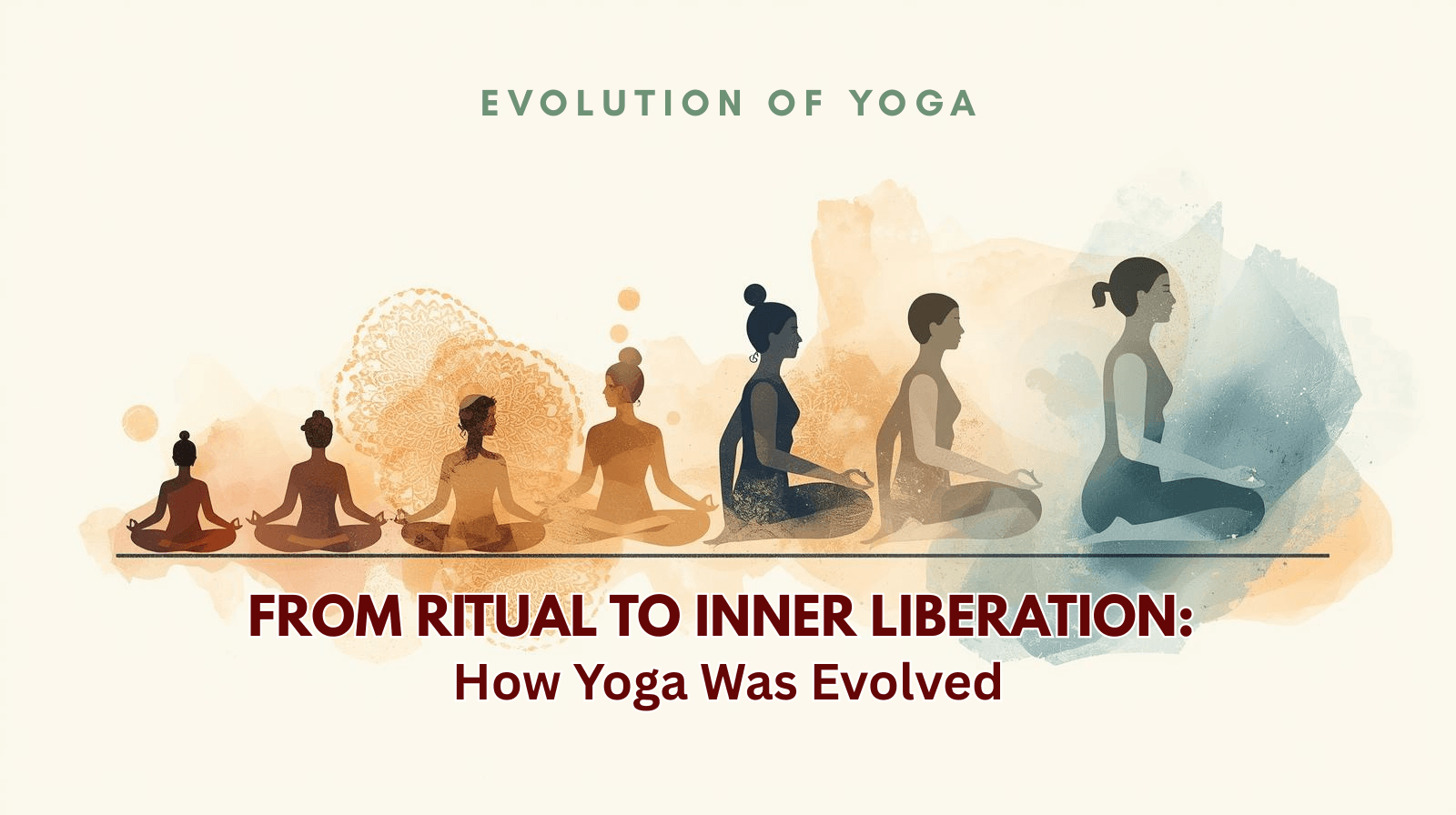
Yoga did not begin as a sequence of postures. It did not even begin as a path of meditation. To understand yoga deeply, we must go back to a time before “yoga” was a spiritual system – to the world of early Vedic ritual.
The World of Fire Altars and Sacrifice
In the earliest Vedic period (c. 1500-1000 BCE), religious life revolved around ritual sacrifice (yajña). Priests performed elaborate fire ceremonies to maintain cosmic order (ṛta), ensure prosperity, and secure heavenly rewards. The root yuj from which the word “yoga” later develops, originally meant to yoke, to harness, to apply effort, often referring to yoking horses to chariots.
There was discipline.
There was concentration.
There was control.
But there was not yet yoga as a path to liberation.
Spiritual life was outward-facing and the ritual action aimed at sustaining the world and pleasing the gods.
The Interior Turn: Early Upaniṣadic Reflection
Between roughly 800-500 BCE, something shifted. The later Vedic texts known as the Upaniṣads began to question whether ritual alone could lead to ultimate freedom. Here attention moved inward. Instead of asking:
“How do we maintain cosmic order through sacrifice?” Thinkers began asking: “Who is the one who performs the sacrifice?”, “What is the nature of the Self?”, “What survives death?”
Practices such as breath control, sense withdrawal, and meditation appear. The goal becomes knowledge (vidyā), especially realization of the identity between ātman (self) and brahman (ultimate reality).
This marks the first interiorization of religious life. Yet this transformation was still embedded in Upanishadic metaphysics. Liberation was understood as realizing an eternal Self.
The Śramaṇa Revolution: Liberation Becomes Urgent
Around the 6th century BCE, a far more radical movement emerged – the Śramaṇa traditions (including early Buddhism and Jainism).
These renunciates rejected:
- Ritual sacrifice as the primary path
- Social hierarchy as spiritually decisive
- Scriptural authority as unquestionable
Instead, they emphasized:
- Direct experience
- Ethical discipline
- Meditation
- Renunciation
- Freedom from the cycle of birth and death
Here, liberation (moksha, nirvāṇa) became an urgent, existential goal and not heavenly reward, not cosmic maintenance, but complete release from suffering.
This is the moment when yoga becomes fully soteriological – a technology of liberation.
Karma is reinterpreted not as ritual action, but as intentional action shaping experience. Meditation becomes central. Discipline is psychophysical rather than ritualistic.
Yoga shifts from fire altar to inner transformation.
Integration and Reinterpretation
Over the centuries, Brahmanical traditions responded and adapted. The Mahābhārata and the Bhagavad Gītā integrate yogic discipline into household life. Yoga becomes action performed without attachment to results i.e. karma-yoga.
Later, the Yoga Sūtra systematizes yoga as a philosophical path grounded in disciplined practice and discriminative knowledge. While incorporating ascetic and meditative insights shared with Śramaṇa traditions, it reintroduces a metaphysical witness (puruṣa) as the foundation of liberation.
Yoga is now no longer ritual sacrifice. It is no longer exclusively renunciate rebellion. It becomes a structured, analytical path of inner discipline.
Why This History Matters Today
Understanding this transformation changes how we approach practice.
If yoga originated as a path of liberation from conditioned existence, then:
- Asana is not merely exercise.
- Breath is not merely relaxation.
- Discipline is not punishment.
- Detachment is not indifference.
Practice becomes a way of examining cause and effect within ourselves. It becomes a training in awareness, restraint, and insight.
When we forget this history, yoga becomes fitness culture.
When we remember it, yoga becomes a path.