What if the real yoga challenge is not touching your toes…
…but loosening your grip on how you think life should be?
Most of us arrive to yoga with a heavy backpack: old stories, expectations, fear of losing control.
We want peace, but we also want guarantees.
Yoga offers something different:
not a perfect life, but a different way of being with life, hrough acceptance, non-attachment, and letting go.
This guide is a gentle, practical introduction to these three big words and how you can start living them today, whether you’re at home, in a city studio, or on a yoga retreat in India.
1. What Acceptance Really Means in Yoga
In everyday language, “acceptance” can sound weak:
“Just accept it”, as if we should give up and stop caring.
In yoga, acceptance is the opposite of giving up.
Acceptance means:
- I see clearly what is happening right now.
- I stop fighting reality with “this shouldn’t be happening”.
- From this honest place, I can choose my next step.
Think of a difficult pose in class.
You can fight your body: “Why can’t I do it? I should be better by now.”
Or you can accept: “Today my hamstrings feel tight. This is where I am starting from.”
Nothing magical happens at that moment… but your nervous system softens.
You breathe again.
You become present.
Acceptance is the doorway.
Without it, we are always battling life in our heads.
2. Non-Attachment: Caring Deeply Without Clinging
If acceptance is the doorway, non-attachment (vairāgya / aparigraha) is how we walk through it.
Non-attachment does not mean:
- “I don’t care about anything.”
- “I should feel nothing.”
Non-attachment means:
- I can love, enjoy and appreciate…
- …without making my happiness depend on one result, one person, or one identity.
Examples:
- You love your job → but you are more than your job title.
- You love your partner → but you don’t collapse if they have a bad day.
- You love your yoga practice → but you are not only “good” when your body is flexible.
Attachment says:
“I am only safe if things go my way.”
Non-attachment says:
“Whatever happens, I will meet it with awareness and kindness.”
This is powerful, because life in modern society is always changing: money, work, health, relationships, even countries. When we cling too tightly, every change feels like death.
3. Letting Go: The Body’s Language for Freedom
Letting go is how acceptance and non-attachment become real in the body.
You know that feeling when you finally drop a heavy bag from your shoulder?
Your body does not need a philosophy lecture. It understands instantly: freedom.
In yoga, we let go in three main layers:
1. Letting Go in the Body
On the mat:
- Notice where you grip: jaw, shoulders, belly, hands.
- In each exhale, soften one small place.
- Do not force, just “invite release”.
Off the mat:
- Shake out your arms and legs during the day.
- Take three slow breaths before answering a stressful message.
This tells your nervous system: “It’s okay. We do not need to fight right now.”
2. Letting Go in the Breath
The breath is a bridge between mind and body.
Try this simple practice:
- Inhale through the nose for 4 counts.
- Exhale through the nose for 6 counts.
- Repeat for 2–5 minutes.
Longer exhales switch the body from fight/flight to rest/digest.
It is like pressing a soft “reset” button.
3. Letting Go in the Mind
Thoughts are the hardest part… because they look so real.
A beginner-friendly way:
- When a heavy thought appears (“I’m not enough”, “I always fail”), silently add:
“…I am thinking this right now.” - Feel the difference between the thought and the awareness that sees it.
You do not have to push the thought away.
You simply stop treating it as the ultimate truth.
4. Simple Everyday Practices for Acceptance & Non-Attachment
You do not need a cave in the Himalayas to practice.
You can start exactly where you are.
Practice 1: The “Yes, And” Breath
When something difficult happens (traffic, delay, conflict):
- Pause and take one breath.
- Say internally: “Yes, this is here.”
- Then ask: “And what small, kind step can I take now?”
This breaks the habit of resistance (“No, this can not be happening!”) and moves you into creative response.
Practice 2: Gratitude Without Possession
Once a day, pick one thing you love: your morning tea, your dog, your child, your favourite song.
Say to yourself:
“I deeply enjoy this… and I know it doesn’t belong to me.”
Feel both: deep appreciation and freedom.
This is non-attachment in its most tender form.
Practice 3: Tiny Releases
Choose one thing you are ready to loosen your grip on. Start very small.
Ideas:
- Unfollow one account that triggers comparison.
- Put your phone in another room for one meal.
- Release one old T-shirt you never wear.
While you do it, say:
“I let this go to create space for what truly supports me.”
Your brain learns that letting go is not punishment, it is space.
5. Why Retreat Life Makes Letting Go Easier
Reading about acceptance and non-attachment is one thing.
Living it is another.
That is why many seekers come to a yoga retreat in India or a yoga teacher training: not only to learn poses, but to experience a different rhythm of life.
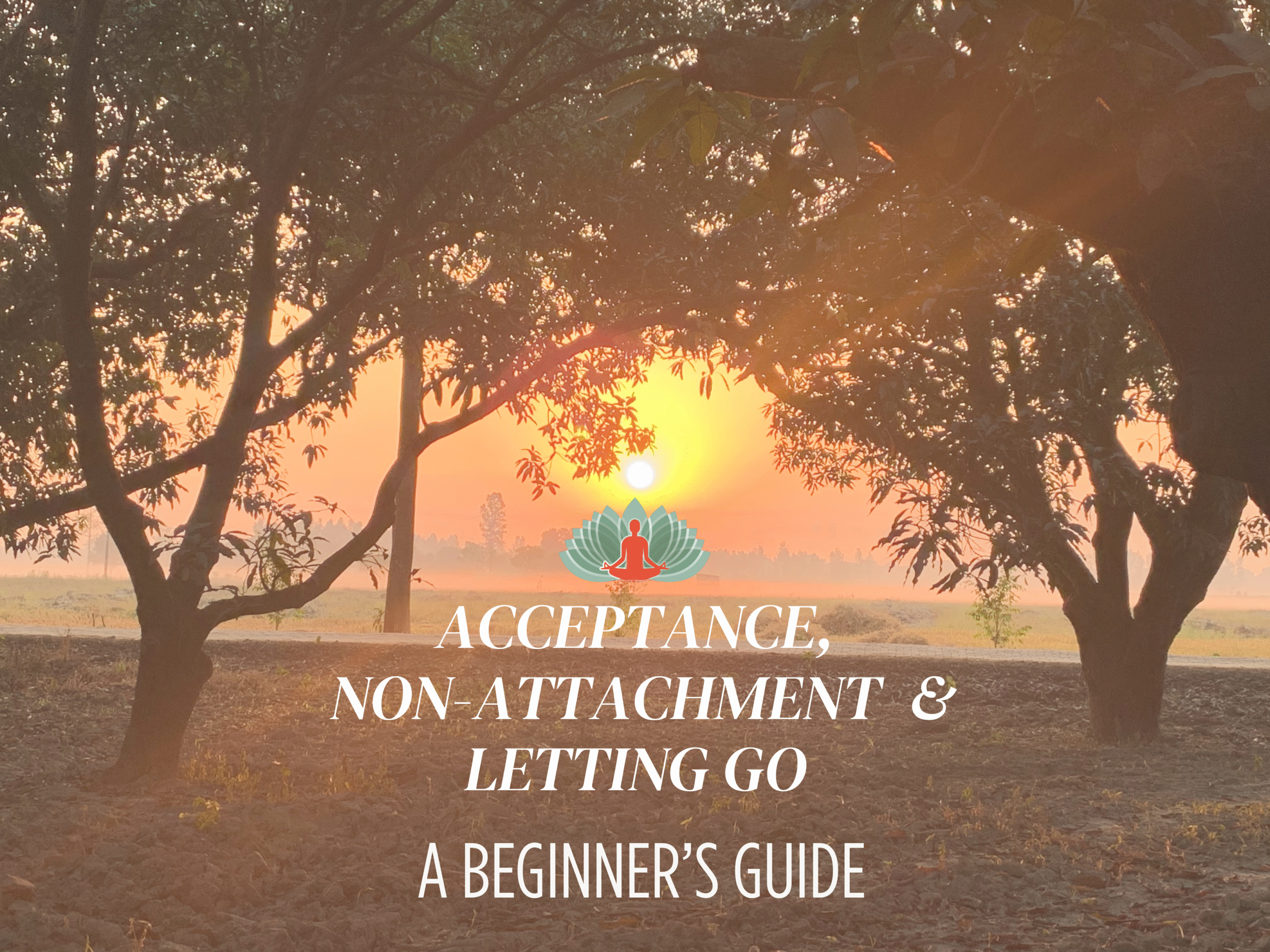
At Akshara Yoga School, our modern ashram sits in rural North India, surrounded by rice fields, buffaloes and open sky. Life here is simple on purpose:
- Small groups, not crowds, so you are not performing; you are supported.
- Farm-to-table vegetarian food, cooked slowly, with care, using our own vegetables and fresh dairy.
- Structured days with spacious time: yoga, breathwork, philosophy, plus quiet moments to listen to yourself.
- Real Indian family life not a hotel, but a home where you are welcomed like a guest, not a customer.
In this environment, something gentle happens:
- You let go of constant notifications.
- You let go of always being “on”.
- You let go of the pressure to be a perfect yogi.
Instead, you start to feel what yoga was meant to be:
a reconnection with who you are underneath the noise.
6. Is It Time for Your Own Letting-Go Chapter?
You do not have to “fix yourself” before you come to an ashram or a yoga teacher training in India.
You come because you’re tired of carrying everything alone.
Acceptance, non-attachment and letting go are not abstract spiritual goals.
They are skills, trainable, practical, human.
Every time you soften your jaw in a pose, breathe through a difficult feeling, or release one tiny expectation… you are already walking the path.
If you feel called to explore this more deeply — with real practice, real guidance and real Indian culture, you are welcome to join us at Akshara Yoga School for:
- Yoga Teacher Training Courses (200hr)
- https://www.aksharayogaschool.com/7-days-yoga-vacation/
- 80-Hour Yoga Foundation Course
Come not for a holiday, but for a turning point:
a space where your mind, body and heart can finally exhale…
and where letting go becomes the most natural thing in the world.