Western philosophy has long wrestled with a single, foundational question: Do we truly know reality, or do we only know our perceptions of it?
Thinkers from John Locke to George Berkeley and David Hume dedicated their lives to this puzzle. Locke openly admitted that our empirical knowledge is merely probabilistic. Berkeley took it a step further, collapsing physical matter into ideas and famously insisting that “to be is to be perceived.” Then came Hume, who stripped away metaphysical certainty altogether. He demonstrated that even the concepts of causation and the “self” are not rational certainties, they are simply habits of the mind.
The Empirical Nature of Yoga
Interestingly, yoga shares this deeply empirical foundation. Yoga does not ask for blind faith; it asks us to directly observe our breath, our sensations, our thoughts, and our awareness. It is a science of direct observation.
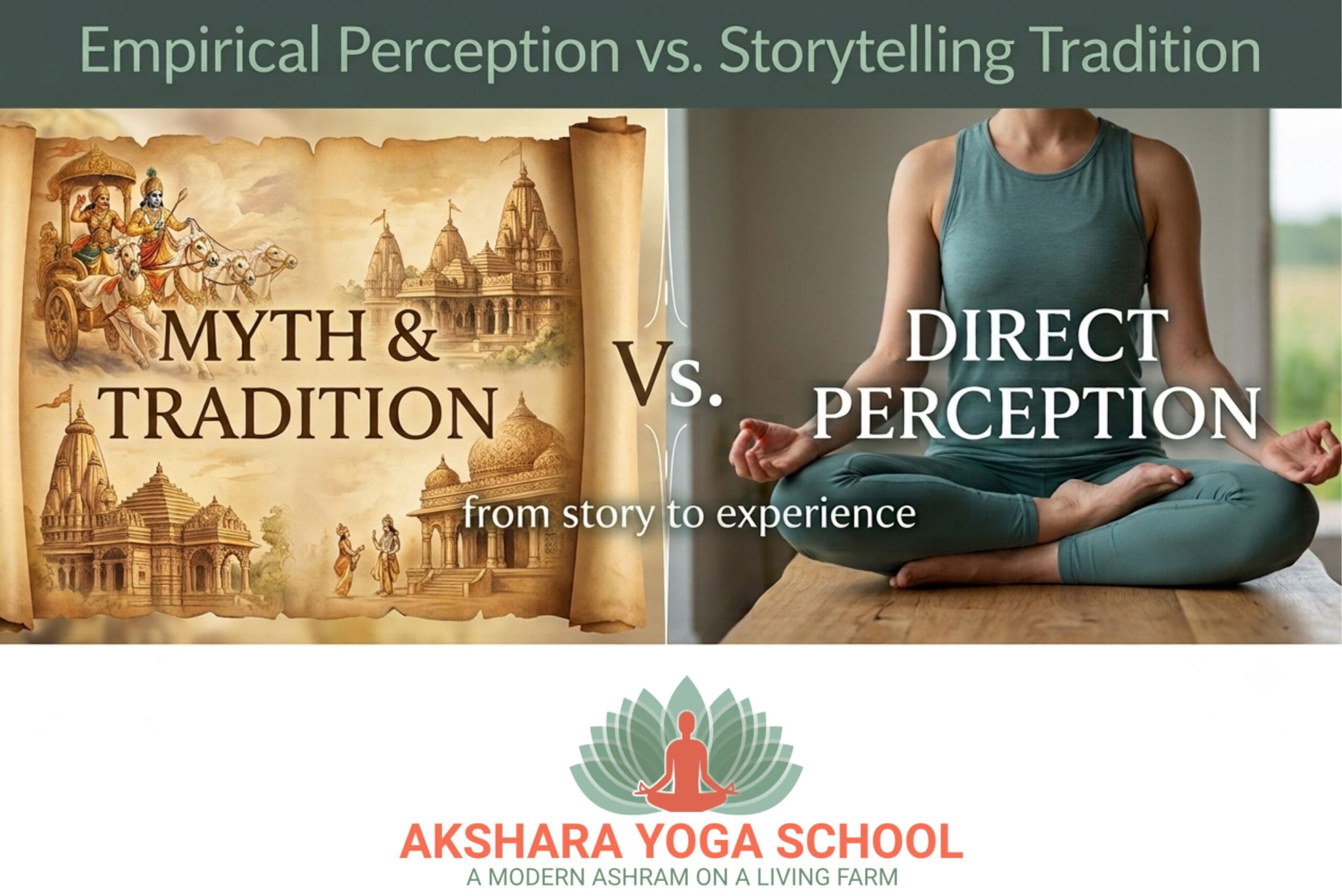
Yet, when we attempt to explain or teach yoga, we frequently borrow stories from ancient epics like the Mahābhārata. While these grand narratives have the power to ignite our imagination, they also carry a hidden risk: they can easily become false authorities.
As human beings, we are inherently gullible. We naturally cling to narratives because they provide us with comfort, identity, and a sense of meaning. However, in gripping tightly to these stories, we often lose the very core of true communication-direct perception.
Finding Moral Courage in the Practice
To honor the true essence of yoga requires a specific kind of moral courage. It means having the clarity to say: this story is not literally true-it is only a pointer.
The ultimate truth of yoga does not reside in myth; it resides entirely in your direct experience.
Just as David Hume stripped away the clutter of metaphysical assumptions to reveal the raw psychology of human nature, yoga strips away the layer of narrative to lay bare the lived, undeniable reality of the body and mind.
The Shift from Belief to Verification
The ultimate challenge for our species is to consciously make this shift:
- From story to perception
- From myth to experience
- From belief to verification
When we stop relying on external narratives and start trusting direct, verifiable experience, that is precisely where true freedom begins. When experience becomes the authority, yoga ceases to be merely something we hear about. It becomes something we know for ourselves.