Living in a World of Extremes
Modern life constantly pushes us toward extremes. We are encouraged to work harder, train harder, achieve faster, and do more – often at the cost of our health, peace, and relationships. When exhaustion sets in, the pendulum swings the other way, toward avoidance, indulgence, or complete withdrawal. Caught between over-effort and burnout, many people feel confused, restless, and emotionally drained. Yoga, in its true philosophical sense, offers a different way forward: the middle path.
What the Middle Path Really Means in Yoga
The middle path in yoga is not about doing less or doing more; it is about doing what is appropriate, conscious, and sustainable. Classical yogic wisdom teaches that it is the imbalance whether physical, mental, or emotional, is at the root of suffering. Too much discipline without softness leads to rigidity and exhaustion. Too much relaxation without structure leads to dullness and lack of direction. Yoga shows us how to walk between these two extremes with awareness and intelligence.
Balanced Discipline in Yogic Practice
In practice, this understanding becomes deeply practical. A balanced yogic discipline encourages consistency rather than intensity. Instead of forcing the body into postures, one learns to listen, adjust, and respect natural limits. Effort is applied, but without aggression. Rest is taken, but without guilt. This approach not only protects the body from injury but also keeps the mind steady and receptive. Over time, practice becomes nourishing rather than draining.
Mindful Rest as a Yogic Skill
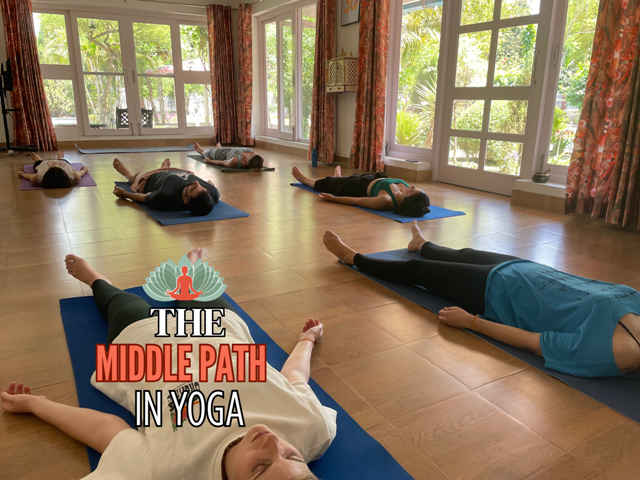
Modern society often glorifies constant activity and labels rest as laziness. Yoga philosophy challenges this belief by teaching that true rest is an essential part of discipline. Mindful rest restores the nervous system, sharpens awareness, and supports emotional balance. When rest is understood as a conscious practice rather than an escape, it becomes a source of strength rather than weakness. This understanding helps practitioners maintain long-term consistency without burnout.
Avoiding the Traps of Modern Extremes
Hyper-fitness and hyper-spirituality are two common traps of modern times. On one side, the body is pushed beyond its capacity in the name of fitness and achievement. On the other, spiritual ideas are chased without grounding in daily life, leading to avoidance rather than growth. The middle path of yoga avoids both. It integrates physical practice with awareness, and spiritual understanding with responsibility. It teaches us to remain present in the world while staying rooted within ourselves.
Living the Middle Path in Yoga Teacher Training
In a yoga teacher training environment, this philosophy is not merely discussed; it is lived. Daily routines are designed to balance practice and rest, study and reflection, silence and communication. Students learn that yoga is not about extremes of effort or withdrawal, but about cultivating steadiness in every situation. Through philosophy classes, practical training, and mindful living, the middle path becomes an embodied experience rather than an abstract idea.
Experience the Middle Path in Practice
Come experience yoga in the countryside of India, where tradition meets personal care. Choose from our 200-Hour Hatha Yoga Teacher Training, our 80-Hour Yoga Foundation Course, our Yoga Vacations, or contact us to create your own Tailor-Made Program. Here, yoga is taught not as an extreme, but as a balanced and conscious way of living.