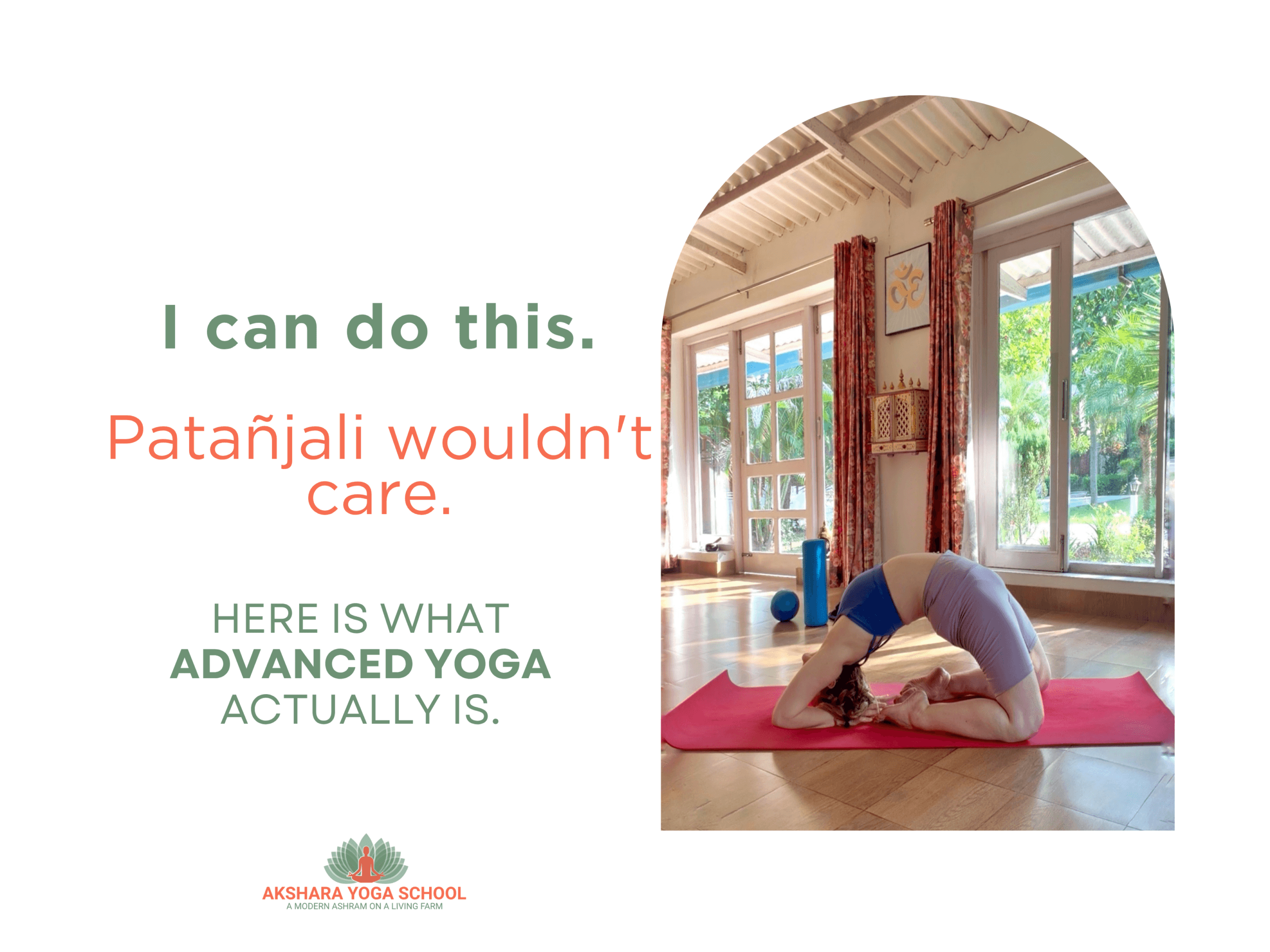
If you scroll through yoga content for five minutes, you will see someone doing a handstand, a full split, or a backbend that requires the spine of a circus performer. This is presented as advanced yoga. It is not. Here is what actually is.
The misunderstanding started with a photograph
Somewhere in the last fifty years, yoga became a visual medium. A pose looks impressive in a photograph. Nervous system regulation does not. So the photograph won, and the definition of “advanced” shifted quietly toward the visual, toward depth, difficulty, and flexibility.
The classical yoga texts do not support this. The Yoga Sutras of Patanjali (the most referenced foundational text in yoga) dedicates three short lines to asana out of 196 sutras. Three lines. The instruction is essentially: find a position that is steady and comfortable. That is the entire asana curriculum according to Patanjali (PYS 2.46–2.48). The rest of the text is about the mind.
This is not an argument against challenging poses. It is an argument about what “advanced” actually means.
What the body is actually practicing
When you hold a pose for two minutes, not forcing, not collapsing, just staying, something specific happens in the nervous system. Your brain receives a constant stream of information from your muscles, joints, and breath. It has to process that information and decide, moment by moment, whether this situation is safe or threatening.
For most people, discomfort triggers an automatic threat response. The shoulders tense. The breath shortens. The mind starts looking for the exit. This happens not because the pose is dangerous but because the nervous system has learned to treat discomfort as danger.
Yoga practice, done correctly, trains the nervous system to tell the difference. You learn to stay present with sensation without escalating it into panic. You learn to breathe through difficulty without shutting down. Over time, this capacity does not stay on the mat. It moves into your daily life, into difficult conversations, frustrating situations, moments when everything feels unstable.
The real definition of an advanced practitioner is not someone who can fold their body into a complex shape. It is someone who can remain calm, present, and clear-headed when the situation is hard. The pose was always just the training ground.
Why this matters more than flexibility
Flexibility is a physical property. It depends heavily on genetics, on the structure of your joints, on how much time you spend stretching. A twenty-year-old with naturally loose hips will always outperform a forty-five-year-old with tight ones, regardless of how committed their practice is. If flexibility is the measure of advancement, yoga has a ceiling and that ceiling is largely determined at birth.
Nervous system regulation has no such ceiling. It is a skill. It can be trained at any age, in any body, in any pose, including simple ones.
A person doing Tadasana, basic standing pose, with complete internal awareness, feeling every point of contact with the ground, tracking the breath, noticing the subtle pull of gravity is doing something genuinely sophisticated. More sophisticated, arguably, than someone forcing a split while holding their breath and gripping their jaw.
This is why at Akshara Yoga School, we do not chase complexity. We teach students to feel what is actually happening inside the body while doing simple, foundational movements. That is harder than it sounds. And it is the foundation of everything that comes after.
The practical test
Here is a simple way to evaluate where your practice actually stands. Not how flexible you are. Not how long you can hold a headstand. Ask yourself this:
When something goes wrong in your day: a conflict, a surprise, a frustration, how long does it take your nervous system to return to calm? Does your breath shorten and stay short for hours? Does your body tighten and stay tight? Or have you developed the capacity to notice what is happening, breathe into it, and come back to stability within minutes?
That capacity is what yoga trains. The pose is the context in which you practice it. A warrior pose held for two minutes of real attention will develop this capacity. The same pose held for two minutes of distracted endurance will not.
The question is never how deep is the pose? The question is always what is the quality of attention inside it?
What this means for your practice
If you have been measuring your progress in yoga by what you can do with your body, this is an invitation to add another layer of measurement. Start noticing how you respond. Not just physically, but in your nervous system to the poses that feel uncomfortable. Notice where you hold your breath. Notice where you grip. Notice what your mind does when a pose becomes hard.
Those are the places where your practice is actually happening. That is where advancement lives. Not in the photograph. In the quality of what occurs inside a pose that may look entirely ordinary from the outside.
Simple poses practiced with this quality of attention will change you in ways that impressive poses practiced without it never will.
At Akshara Yoga School, we teach traditional Hatha Yoga in rural India, clearly, practically, without mythology or performance.
If you want to understand what yoga actually trains and how to apply it in real life, our 200-hour Teacher Training and Foundation Courses are built around exactly this.