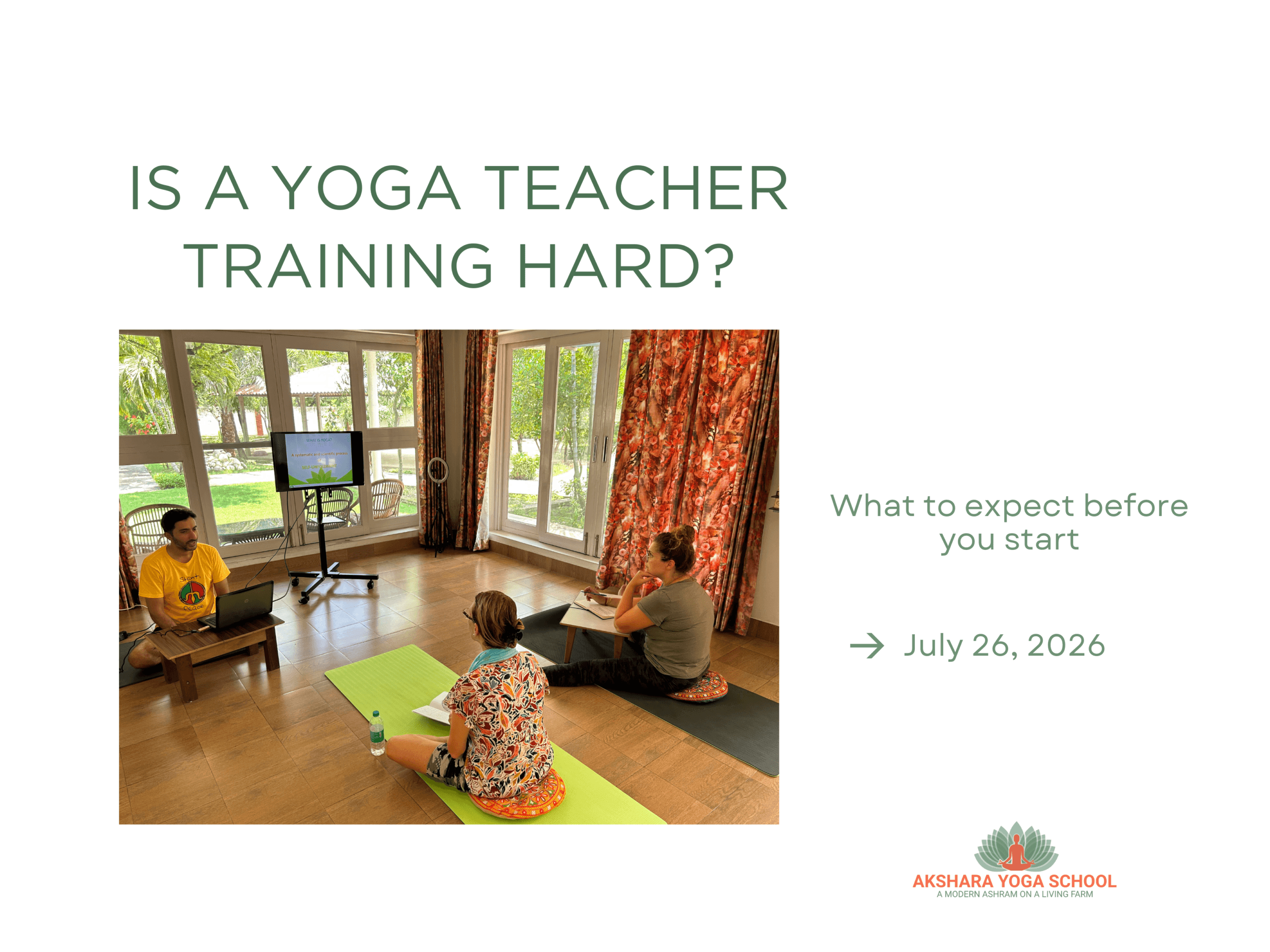
A 200-hour Yoga Teacher Training Course can open new doors. It can change how you see your body, your mind, and your life. This is true. But it isn’t the whole picture. You may find some parts that are hard.
What does a typical day look like on a 200-hour YTTC?
You wake up much earlier than you are used to. Your meals change. Your sleep changes. For a few days, your body doesn’t know what’s happening.
The program is full. You are learning and practicing from early morning until late afternoon, most days. There isn’t much empty time. If you are used to a slower pace, this can feel like a lot, especially in the first days.
At Akshara, we build the first week as an adjustment period on purpose. We know the body needs time before it can settle into something new. But even with that, the first days are still an adjustment. We won’t pretend they aren’t.
Is it hard to adjust to a new country during training?
If you are coming from abroad, you are not only adjusting to early mornings and a full schedule. You are also adjusting to a different country. The climate is different. The food is different, and your stomach needs time to get used to it. There may be insects you are not used to seeing. You are in a rural place, away from city comforts, and the language around you may not be your own.
This is part of the experience, not a flaw in it. But it’s real, and it takes energy on top of everything else you’re learning. Give yourself time for this too.
What is it like living with other trainees?
In a residential training, you’re usually living closely with other people, sharing space, meals, and daily life with people you didn’t choose and don’t know yet. That can be wonderful. It can also be tiring. Less personal space, different habits, different personalities.
At the same time, some trainings are small. Sometimes you may be the only trainee in the group. There’s no cohort of classmates to share the experience with, no one going through the same days at the same pace as you. Both of these: close daily contact with others, or training on your own are part of what a small, personal school looks like, and both take some getting used to.
Is a YTTC only about yoga poses?
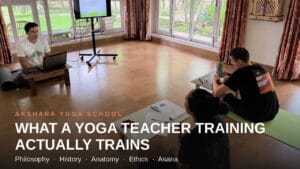
People often think a Yoga Teacher Training Course is mostly about asana, the physical postures. It isn’t. In four weeks, you are also learning anatomy, the history and philosophy of yoga, how to safely adjust another person’s body, and ideas like karma yoga, which is about action and service, not just movement.
That’s a lot of information arriving at once, from a lot of different directions. Some days your mind will feel full. That’s normal. It doesn’t mean you are behind or that you are not capable.
How physically demanding is a yoga teacher training?
By the second week, you are going deeper into the practice. Your body has been working hard and often in new ways. You might feel tired. You might feel sore in places you didn’t expect. This isn’t a sign that something is wrong. It’s a sign that your body is doing real work.
Will I feel emotional during a yoga teacher training?
A training like this asks a lot of you, not just physically. When you spend weeks paying close attention to your breath, your body, and your mind, things can come to the surface. Thoughts, feelings, memories you weren’t expecting to think about.
This is a normal part of a process like this. It doesn’t mean something is wrong with you. It means you are paying attention to yourself in a way you may not have before. If this happens, be patient with yourself. You don’t need to solve everything in four weeks. You just need to notice it.
Is it normal to compare yourself to other trainees?
You’ll be practicing next to other people every day. Some more flexible than you, some who pick up a pose faster, some who seem completely at ease with something you’re struggling with. It’s natural to notice these differences and, at some point, to compare yourself.
Try to remember why you’re there. You didn’t come to be the best in the room. Everyone in a YTTC started from a different place, different bodies, different practice histories, different reasons for being there. Progress in yoga isn’t measured against the person next to you. It’s measured against where you started.
Will a YTTC challenge what I already believe?
Yoga has a long history, and some of its ideas may be new to you, maybe even different from things you have believed for years. This can be uncomfortable.
Here is what we ask of every student: don’t believe something just because a teacher said it. Take what you hear, think about it, question it, look into it yourself. A good training gives you a foundation to think from. It doesn’t hand you a finished belief system to accept without question.
The course is the beginning. What you do with it afterward, how you keep learning, how you keep practicing, how you keep asking questions, that’s the real journey. We can only give you the start of it.
Why we are telling you this
We could write a blog that only shows you the beautiful parts of a Yoga Teacher Training Course. There are plenty of those, and they are true. But we would rather you arrive prepared than surprised.
If you know that the first week will ask something of your body, that the middle weeks will ask something of your mind, and that some of what you hear may need to be questioned rather than swallowed whole, you will be in a much better position to actually receive what the training has to offer.
That’s what we try to build at Akshara: a place where the hard parts are expected, not hidden, and where you leave with a foundation, not a finished answer.
If you are ready to see whether this is the right fit for you, take a look at our upcoming 200-hour YTTC.