One of the most beautiful words in Indian philosophy is anubhava.
Yoga repeatedly asks us not to believe but to experience. Teachers encourage us to verify teachings through our own experience rather than accepting them blindly. This is anubhav or experience.
Etymologically, Anubhava breaks down into:
- Anu = “following,” “along with,” or “in direct response to.”
- Bhava = “being,” “becoming,” or “state of reality”.
So, Anubhava literally means “direct, immediate apprehension of reality as it becomes”– not a memory (Smriti), not an intellectual theory, and not an abstract mental story.
In Pāli, the Buddha often used anubhava in the sense of direct knowing through lived experience, not through hearsay or speculation. This is why the Dhamma is described as sanditthiko “visible here and now.” Therefore, the word is anubhava, is used with the sense of directly experiencing or personally realizing something rather than merely hearing about it.
Experience Begins with Direct Sense Perception
The first level of experience in yoga is remarkably simple. We begin by observing what is immediately available through our senses. We notice the movement of the breath, the sensation of muscles stretching, the warmth of the body after practice, the beating of the heart, or the feeling of tension slowly dissolving during relaxation. These observations do not depend on belief or imagination. They are direct experiences available to every practitioner. Before yoga becomes philosophy, it first becomes careful observation of reality as it presents itself.
From Observing Events to Understanding Cause and Effect
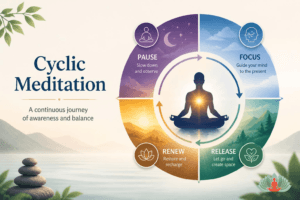
As awareness deepens, experience becomes more refined. We no longer notice isolated sensations, we begin to understand relationships. During an asana practice, we may observe that stiffness gradually gives way to ease when the body is approached patiently rather than forcefully. In Cyclic Meditation, we experience that a period of gentle stimulation through movement is naturally followed by a deeper state of relaxation. Slow, conscious breathing quietens the mind. Rushing the breath creates restlessness. These are not theories borrowed from a book. They are relationships between cause and effect discovered through direct experience. Yoga gradually trains us to see not only what happens but also why it happens.
The Deepest Experience Is the Observation of the Mind
The most transformative experiences in yoga are not limited to the body. They arise when we begin observing the mind itself. Imagine someone criticizes you. Instantly anger arises, and the natural tendency is to conclude, “That person made me angry.” Yoga invites us to observe more carefully. If awareness is sustained, we begin to notice that the words themselves are only an external event. The suffering arises because the mind reacts with resistance, attachment, expectation, or hatred. Gradually, a profound realization emerges: my suffering is not created solely by another person; it is also created by the way my own mind responds.
This is no longer philosophy. It is anubhava. It is a direct insight into the workings of one’s own mind, and such an insight has the power to transform the way one lives.
Embodied Experience Transforms Life
Reading that hatred creates suffering is information. Watching hatred arise within oneself and seeing how it disturbs the mind is experience. Hearing that attachment leads to anxiety is philosophy. Discovering this truth in one’s own life is anubhava. This is why embodied experience carries such transformative power. Once a person directly sees that resentment harms the one who holds it, or that awareness of the breath immediately softens mental agitation, these truths no longer remain ideas. They become lived realities.
Yoga is not asking us to collect concepts. It is inviting us to investigate ourselves. Every posture, every breath, every emotional reaction becomes an opportunity to learn how the body and mind actually function.
Experience Alone Is Not Enough
In Indian philosophy, anubhava (experience) is not automatically “true knowledge.” It is raw, lived experience i.e. embodied, direct, and personal. Whether it becomes true knowledge depends on whether it is tested and validated empirically.
The relationship between experience and knowledge can be understood as follows:
| Category | Nature | Outcome |
|---|---|---|
| Experiential + Empirical | Direct, embodied, repeatedly observed, understood through cause and effect | Reliable knowledge (jñāna) |
| Experiential but Non-Empirical | Personal, subjective, not critically examined or verified | May inspire inquiry but is not yet reliable knowledge. False knowledge, mysticism, dogma |
| Empirical Observation | Careful observation of patterns, causality, and verification | Always begins with direct experience and matures into understanding |
This is the genius of yoga. It does not ask us to collect extraordinary experiences. It asks us to observe ordinary experience so carefully that truth gradually reveals itself. The breath, the body, the mind, our reactions, our attachments, and our suffering become the laboratory. Through repeated observation, experience matures into wisdom, and wisdom becomes transformation.