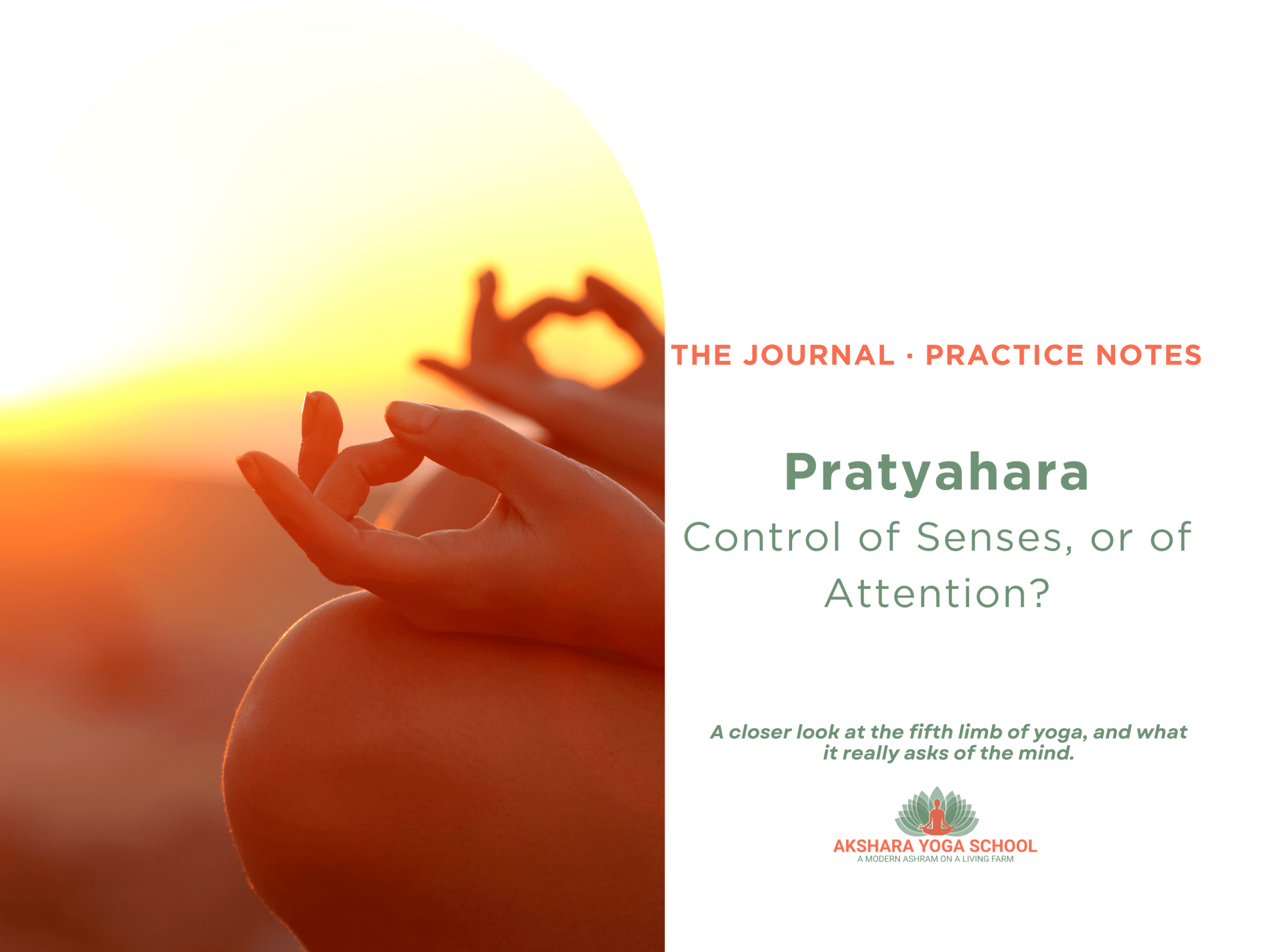
Pratyahara is the fifth limb of yoga according to Patanjali’s Yoga Sutras. It means attention stops being pulled automatically by everything we see, hear, smell, taste, or touch around us. This is a big idea, so let’s slow down and understand it piece by piece.
Definition
Patanjali defines pratyahara in Yoga Sutra 2.54: when the mind draws inward, the senses follow it, instead of chasing outward objects. Sutra 2.55 adds that this gives us the highest mastery over the senses. In simple words: instead of your senses controlling your attention, your attention starts to lead your senses.
That is the definition. Now let us see why it matters and how it actually works.
Why We Start at the Gross Level
Before we try to work with the mind directly, which is abstract and hard to observe, it helps to look at something concrete: how our senses pull us around every day. This is called the gross level, because it is obvious and easy to notice, unlike subtler mental states.
Here are examples anyone can recognize:
Overconsumption. You walk past a shop window. You didn’t plan to buy anything. But the display, the colors, the lighting are built to catch your eye, and a few seconds later you are inside, looking at something you didn’t need five minutes ago. Your eyes pulled your attention, and your attention pulled your action.
Food. You are not hungry, but you see food, or smell it, or simply see other people eating, and suddenly you want to eat too. This is a well-documented pattern in how humans respond to sensory cues around food. Sight and smell can trigger appetite even without real hunger.
Screens. A notification sound, a flash of color on your phone, and your hand moves before you’ve decided anything. The senses reacted first and the thinking came after, if it came at all.
None of this means your senses are the enemy. It means they are powerful, and most of the time, they are driving instead of you. Pratyahara begins the moment you can notice that gap between a sensory pull and your response to it.
How Pratyahara Actually Develops
Textually, in Patanjali’s system, pratyahara comes after pranayama (breath practice) and before dharana (concentration). It’s not the first thing you do, and it’s not something you jump into directly.
In practical daily practice at Akshara, we see it unfold in stages. Shavasana settles the body. Pranayama slows and steadies the breath. Dharana holds attention on one single point. Pratyahara is not a separate technique squeezed in between. It is what happens naturally as the nervous system settles and attention becomes steady enough that it stops being dragged outward.
This matters, because pratyahara is often taught as if it were a trick: close your eyes, block your senses, done. That’s not accurate. You cannot force your senses to withdraw by trying hard. It happens as a result of steady practice, not as an act of willpower.
Can a Teacher Actually Give You Pratyahara?
No. And this is worth being honest about.
In asana, a teacher can touch you, physically adjust your position, which is direct intervention on the body. Pratyahara doesn’t work that way. A teacher can only give instructions and set up the right conditions: sequence, breath rhythm, silence, a steady environment. The withdrawal of the senses itself happens inside your own nervous system. No one can hand it to you.
What a teacher training actually gives you is something different and just as valuable: the ability to build those conditions for yourself, and eventually to hold that space for others.
The Benefits
When pratyahara starts to develop, the changes are practical, not mystical. You react less automatically to what happens around you. Your nervous system becomes more regulated. You can hold focus without every sound, notification, or passing thought pulling you away from what you’re doing.
How We Teach Pratyahara at Akshara Yoga School
In our 200-hour YTTC, we don’t present pratyahara as a mysterious state to chase. We teach it as a skill that grows out of a specific sequence: physical settling, breath regulation, and sustained concentration practice, done consistently, day after day. Students learn to notice their own sensory triggers first: a) the small, gross-level pulls like sound, food, or visual stimulation, before working with b) subtler layers of attention.
This is a practical, body-based approach: no guesswork, no vague spiritual language, just a clear progression that students can actually observe happening in themselves over the weeks of training.
Enroll in our 200-hour YTTC here at Akshara Yoga School. If you want to understand yoga through a clear, structured, and honest process.