Yoga is one of the world’s most enduring spiritual and physical disciplines, yet its actual history is far more dynamic, nuanced, and complex than popular myths suggest. Rather than emerging fully formed as an ancient, unbroken Vedic tradition, yoga evolved across millennia through a blend of intense philosophical debates, scientific discoveries, and cross-pollination between diverse spiritual movements.
Here is a look at how yoga truly developed from its earliest roots to the physical and subtle body practices of the medieval period
1. Early Roots: What the Ancient Texts Actually Say
Many popular writers attempt to trace modern yoga straight back to the ancient Vedas, but historical evidence paints a much different picture. Before 500 BCE, there is very little direct evidence of yoga as a systematic practice involving physical postures (āsana), breath control (prāṇāyāma), or structured meditation.
While early Sanskrit texts mention practices resembling precursor disciplines, scholars caution against viewing them as a complete yoga system:
- The Ṛg Veda (1500–1200 BCE): Mentions visionary meditation and describes a long-haired, ascetic sage possibly a forerunner to later yogis.
- The Atharva Veda (c. 1000 BCE): Introduces the Vrātya, a figure living at the edges of Vedic society who may have practiced posture and breath retention, though this remains speculative.
- Jaiminīya Upaniṣad Brāhmaṇa (c. 800–600 BCE): Teaches early breath control and mantra repetition.
- Indus Valley Seals (c. 2800 BCE): While some point to seated figures on ancient seals as proof of ancient yoga, scholars agree these images do not conclusively prove a yogic culture.
Fun Fact: The word “yoga” in the original Vedic context did not mean spiritual union or physical exercise. It literally referred to yoking horses to a chariot, particularly in the context of war. Over time, this literal meaning evolved into a spiritual metaphor such as in the Mahābhārata, where warrior heroes ascend to heaven using a “yoga chariot.”
2. The Śramaṇa Traditions: Yoga’s True Non-Vedic Roots
Around 500 BCE, a monumental shift transformed Northern India’s spiritual landscape. Renunciant seekers known as Śramaṇas (“strivers”) including early Buddhists, Jains, and Ājīvakas emerged outside the traditional Vedic authority, predominantly in the Greater Magadha region.
Unlike the Vedic focus on caste and ritual sacrifice, the Śramaṇas concentrated on ending the cycle of suffering, karma, and rebirth (saṃsāra). To achieve liberation (mokṣa or nirvāṇa), they developed structured meditation techniques (dhyāna) aimed at erasing karmic traces.
EARLY HISTORICAL EVOLUTION:
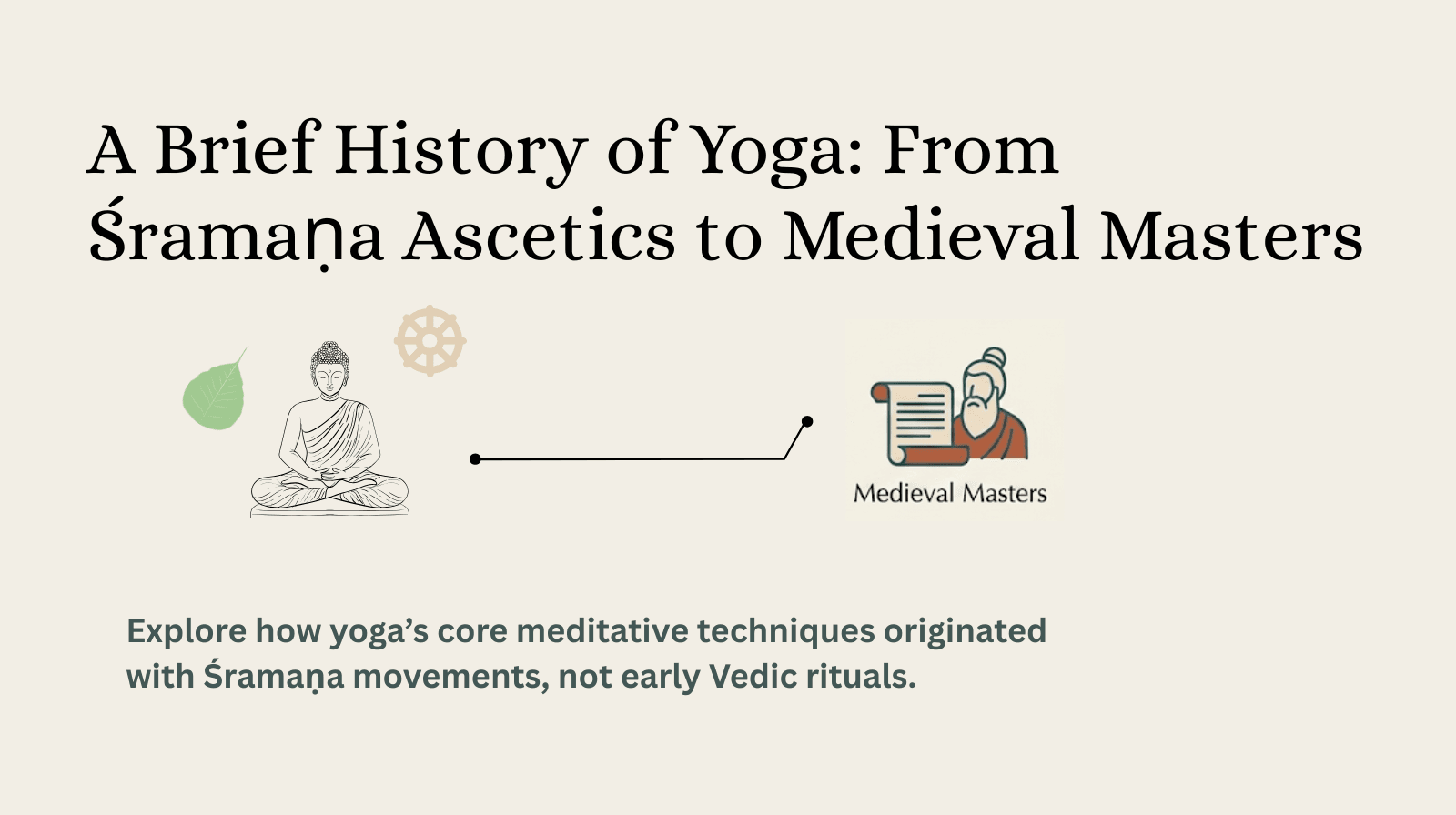
Śramaṇa Movements ──► Buddhism / Jainism ──► Brahmanical Synthesis (Mahābhārata)
This was the first clear appearance of organized yogic practice. These non-Vedic movements did not initially use the term “yoga” for their practices. It was later Brahmanical texts, such as the Mahābhārata (300 BCE–300 CE), that began labeling these meditative techniques as dhyānayoga. Eventually, Buddhists and Jains adopted the term as well.
3. Cosmic Time, Scientific Discovery, and the Rise of Asceticism
The intense rise of Śramaṇa austerities was directly tied to a major intellectual explosion in ancient India. Advances in astronomy and mathematics revealed that planetary movements occurred over vast, endlessly repeating cycles of cosmic time (eons).
This scientific realization created an existential crisis:
- Rebirth was no longer seen as a positive continuation of identity, but as a burdensome, infinite loop of suffering.
- Spiritual seekers shifted their goal: rather than perpetuating identity across lives, they sought to escape timebound existence entirely.
Redefining Karma
The Buddha and contemporary Śramaṇa teachers redefined karma from a mechanism of cosmic order into an existential trap. To achieve freedom, practitioners had to:
- Stop generating new karma through strict moral conduct.
- Burn away old karma through disciplined intense practice (tapas).
- Dissolve the illusion of a static “self.”
4. The Ascetic Foundation: Tapas and the Path to Haṭha Yoga
Central to both Śramaṇa and Vedic traditions was tapas (literally meaning “heat”), referring to intense physical or mental disciplines aimed at radical transformation.
| Tradition | Primary Purpose of Tapas |
| Vedic Traditions | Performed to gain boons, spiritual power, or worldly advantages from the gods. |
| Śramaṇa Traditions | Used to still the mind, burn off past karma, and achieve liberation (mokṣa). |
Over time, tapas became the recognized foundation for yoga. Breath control (prāṇāyāma) was classified as a form of tapas, and texts like the Pātañjalayogaśāstra framed tapas as an absolute prerequisite for serious practice.
Extreme ascetic acts such as the ūrdhvabāhu practice of holding an arm in the air for years eventually evolved into the physical locks (mudrās) and postures (āsanas) of Haṭha Yoga in the second millennium CE. Haṭha Yoga brought these intense techniques out of isolated renunciant environments and adapted them for householders and everyday practitioners
5. Systematization: Patañjali & Yogācāra Buddhism
Between 325 and 425 CE, yoga underwent a massive process of codification in the Pātañjalayogaśāstra (traditionally attributed to Patañjali).
This text represented a Brahmanical appropriation of yoga. It took the core meditative techniques developed in non-orthodox Śramaṇa movements and reframed them using classical Sāṃkhya metaphysics and Vedic authority. By integrating the Eight Limbs (aṣṭāṅgayoga), cognitive absorption (samādhi), and moral guidelines, the text harmonized yogic practice with orthodox society while distancing it from Buddhist and Jain influence.
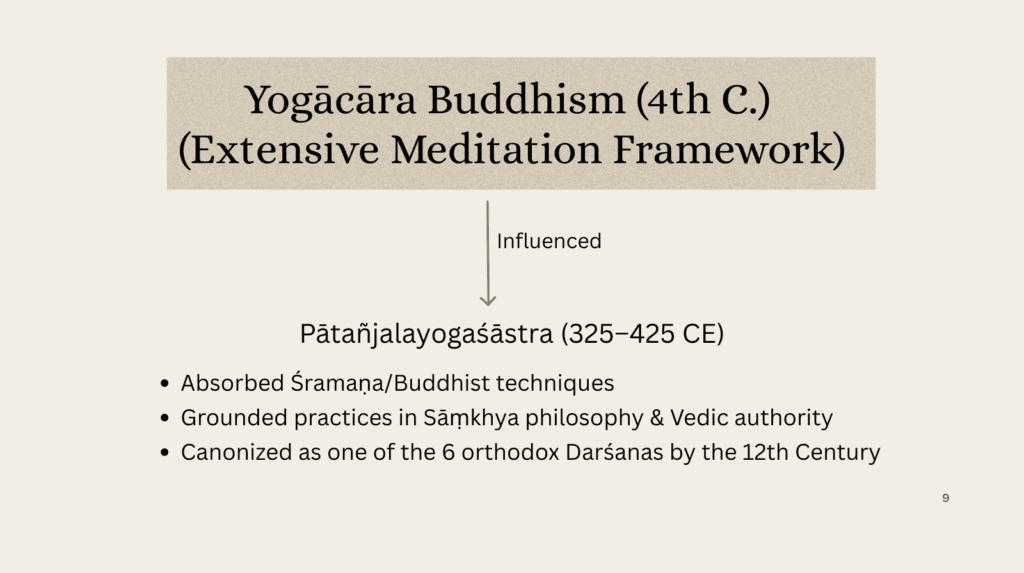
Parallel to this, the Buddhist Yogācāra school had developed its own massive corpus, such as Asaṅga’s Yogācārabhūmi-Śāstra (4th century CE). While Yogācāra heavily influenced the structure of classical yoga, it was later excluded as Buddhism declined in India, leaving the Pātañjalayogaśāstra as the recognized canon
6. Tantra and the Birth of the Subtle Body
Between the 6th and 13th centuries CE, India saw the rise of Tantra. It is a shared spiritual framework adopted across Śaiva, Vaiṣṇava, and Buddhist traditions. Tantra moved away from Vedic sacrificial rituals and focused on direct, highly effective “spiritual technologies,” including mantras, deity visualizations, and energy practices.
Tantra revolutionized yoga by introducing the concept of the subtle body:
- Nāḍīs: A vast network of subtle energy channels running through the body.
- Cakras: Focal energy centers or “wheels” along the central channel.
- Kuṇḍalinī: A dormant spiritual energy located at the base of the spine, which is awakened and guided upward to the crown of the head to achieve divine realization.
THE HISTORICAL CHAIN OF YOGA:
Śramaṇa ──► Mahāyāna ──► Vajrayāna ──► Śaiva Tantra ──► Haṭha Yoga
Summary Key Insights
- Non-Vedic Roots: Yoga’s core meditative techniques originated primarily with non-Brahmanical Śramaṇa movements (Buddhism, Jainism, Ājīvakas), not early Vedic rituals.
- Cosmic Motivation: Ascetic practices (tapas) expanded in response to astronomical discoveries of vast cosmic eons, turning yoga into a tool to end timebound suffering and karmic repetition.
- Brahmanical Synthesis: Texts like the Pātañjalayogaśāstra synthesized Śramaṇa practice with Sāṃkhya philosophy, establishing yoga as an orthodox system.
- Tantric Innovation: Medieval Tantric movements introduced subtle body dynamics – nāḍīs, cakras, and Kuṇḍalinī – which directly laid the foundation for physical Haṭha Yoga systems.