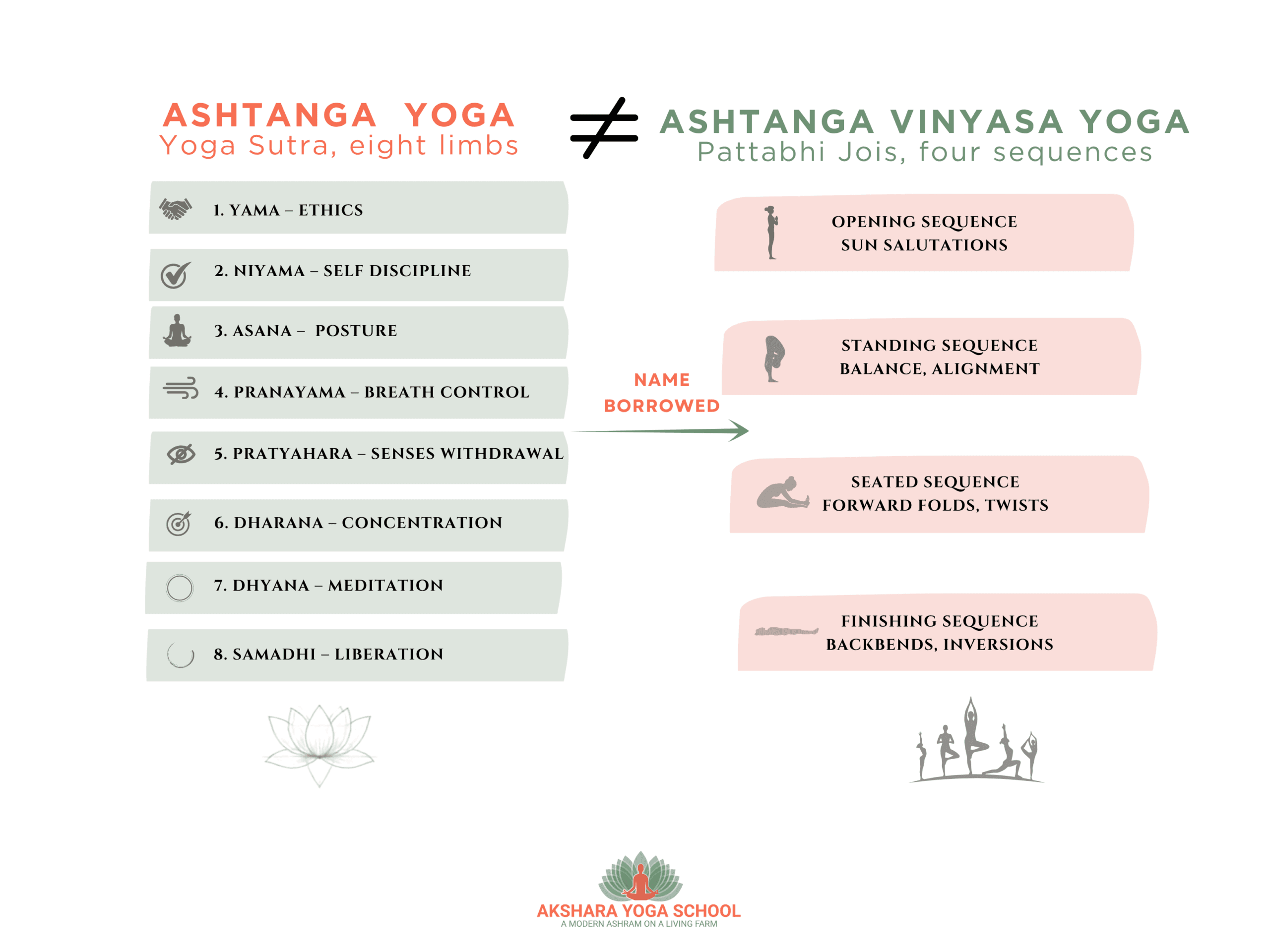
A problem we see again and again at Akshara.
Almost every student who arrives at Akshara Yoga School already has an idea of what “Ashtanga Yoga” means. Usually, that idea is: fast movement, sun salutations, a strict sequence of poses linked to breath. This is not wrong, it is simply incomplete. It describes one specific system, created in the 20th century by the famous Indian teacher, Pattabhi Jois. It does not describe the original meaning of the word “Ashtanga” at all.
This mix-up is not a small detail. It affects how students understand yoga itself, and it is one of the most common misunderstandings we correct in our Hatha Yoga Teacher Training Courses.
Where the confusion starts
The word “Ashtanga” means “eight limbs.” It comes from the Yoga Sutra, a foundational text of yoga philosophy, traditionally attributed to a sage named Patanjali. In the Yoga Sutra, “Ashtanga” is not a style of physical practice. It is a description of eight steps for how a person can live and train the mind:
- Yama — how you treat others
- Niyama — how you treat yourself
- Asana — a steady posture, originally for meditation, not a full sequence of poses
- Pranayama — control of the breath
- Pratyahara — turning attention inward
- Dharana — concentration
- Dhyana — sustained meditation
- Samadhi — deep mental stillness
Notice something important here: only one of these eight steps, Asana, has anything to do with physical postures at all. The other seven are about ethics, breath, attention, and the mind. This is a system for living, not a workout.
Centuries later, in the 20th century, an Indian yoga teacher named Pattabhi Jois developed a specific method of physical practice: fixed sequences of postures, linked together with breath and movement, practiced in a fast, flowing rhythm. He named this method “Ashtanga Vinyasa Yoga,” connecting it to the ancient word from the Yoga Sutra.
This was a reasonable choice on his part. The new method did use breath and movement with intention, and the word “Ashtanga” carried the authority of an old and respected text. But over time, in gyms, studios, and social media around the world, the longer name “Ashtanga Vinyasa Yoga” quietly became just “Ashtanga Yoga” and the original meaning of the word got left behind.
Why this matters for students, not just historians
You might ask: does it really matter what we call it, as long as people are practicing? We think it does, for a simple reason: if a student believes that “Ashtanga Yoga” is the complete, original teaching of the Yoga Sutra, they will misunderstand what yoga actually asks of them.
They may think yoga is primarily a physical challenge, based on how many sun salutations, how deep a backbend is or how strong a handstand is. But the actual eight-limbed path places physical postures as only one part of a much larger structure, most of which has nothing to do with flexibility or strength at all. A student who never learns this may spend years working hard on their body while missing most of what the original system was built to teach.
We also see a second effect. Students sometimes feel discouraged in their practice because they cannot keep up with a physically demanding vinyasa sequence, and they conclude that they are “bad at yoga.” In reality, they may simply be evaluating themselves against one modern physical method, not against yoga as a whole. Separating the two (the ancient framework and the modern method) removes this unnecessary pressure.
What we are not saying
We want to be precise here, because this point is often misunderstood. We are not saying that Ashtanga Vinyasa Yoga is a lesser or incorrect form of yoga. It is a well-structured, disciplined physical practice, and many students benefit from it. We are also not saying that Pattabhi Jois did anything wrong by using the word “Ashtanga” for his method. Many yoga styles borrow old Sanskrit terms to describe newer practices. This is common across the yoga world, not unique to one teacher or one lineage.
What we are saying is narrower and, we think, more useful: two different things share one name, and knowing the difference gives you a clearer, more accurate understanding of both.
Why we teach it this way at Akshara
At Akshara, our Hatha Yoga Teacher Training Course spends real time on this kind of historical and philosophical grounding, alongside physical practice. Our goal is not to make students suspicious of modern yoga styles, including Ashtanga Vinyasa. Our goal is to give students the tools to tell the difference between an ancient philosophical framework and a modern physical method, so that when they teach, or simply practice, they know exactly what they are doing and where it comes from.
Understanding this distinction does not make your practice less valuable. It makes it more accurate. And for anyone planning to teach yoga themselves one day, accuracy is not optional, it is the foundation everything else stands on.