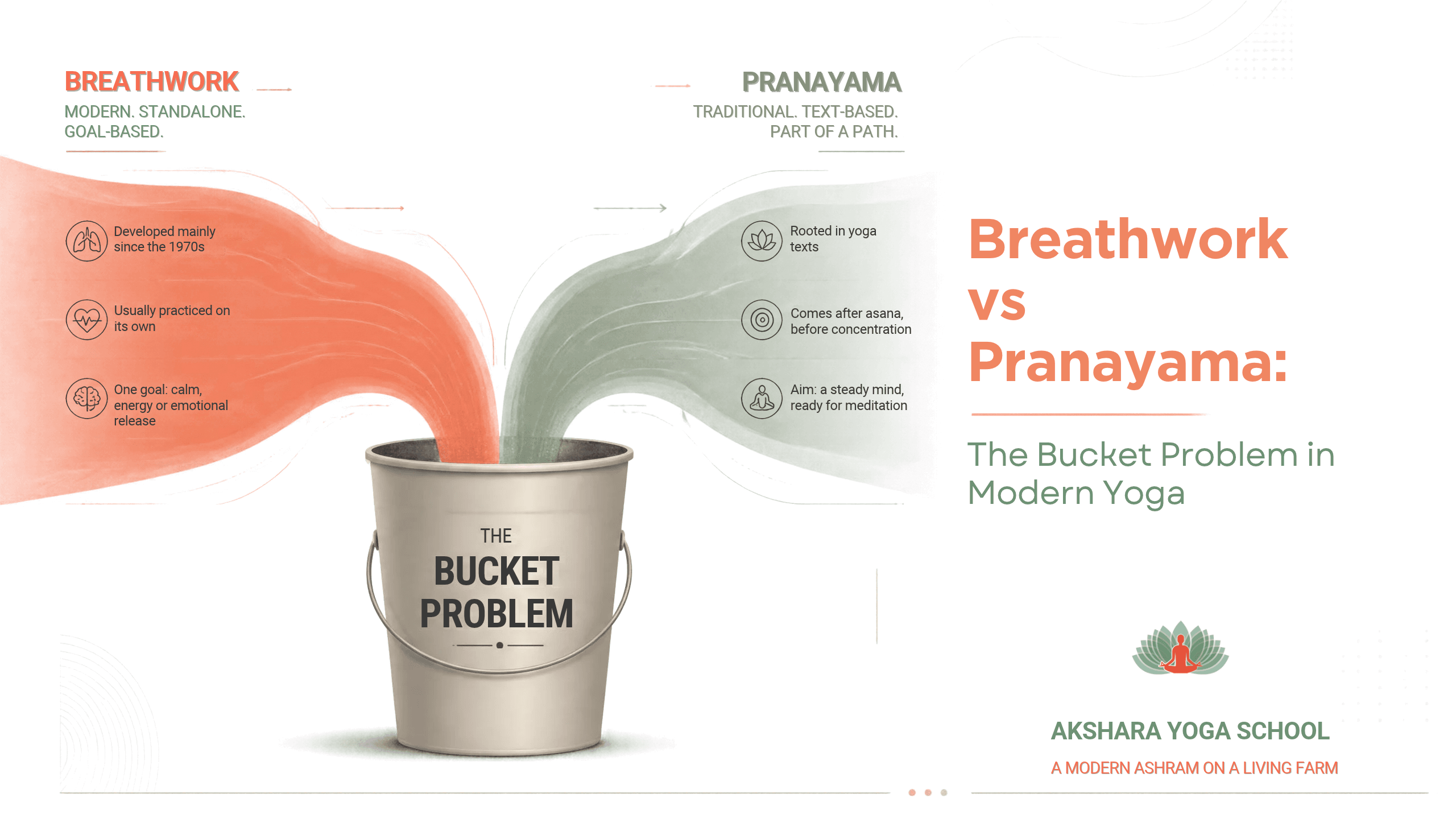
The Bucket Problem
Picture a big bucket. We throw in Wim Hof breathing, box breathing, Holotropic breathing, alternate-nostril breathing, Bhastrika and Ujjayi. Then one label goes on the bucket: “Breathwork.” Or sometimes the other label: “Pranayama.”
This is the bucket problem. When everything goes into one bucket, we lose the most useful information about each practice: where it comes from, what it is for, and who it is safe for.
The reason is simple. All these methods change the way you breathe, so from the outside they look alike. A short video has little time for history. So practices that look similar end up with the same name.
This question comes up often in our Hatha Yoga teacher training course. So let’s take the bucket apart, one practice at a time.
What Is Breathwork?
Breathwork is a modern word for many different breathing methods. The field grew mainly in the West from the 1970s, with methods such as Holotropic Breathwork and Rebirthing. Later came methods such as box breathing and Wim Hof breathing.
Breathwork methods usually:
- are practiced on their own, as a complete session
- aim at one clear goal: to relax, to get more energy, to focus, or to release emotions
- draw on modern physiology, psychology and sports training
Some breathwork methods took ideas from pranayama and other Eastern practices. Wim Hof, for example, names Tibetan Tummo as an inspiration.
Breathwork is not “fake” or “wrong.” Some slow breathing methods are well studied for stress. It is simply a different thing from pranayama.
What Is Pranayama?
Pranayama is the breath training of yoga. It has written sources, a long history and a clear place inside a larger system. Breath control already appears in Indian texts from more than 2,000 years ago.
Two texts are central:
- The Yoga Sutra (around the 3th–4th century CE) names pranayama as the fourth of eight steps, after posture (asana) and before concentration. It describes pranayama as regulating the flow of the in-breath and out-breath (2.49), and says it makes the mind ready for concentration (2.53).
- The Hatha Yoga Pradipika (around the 15th century CE) describes eight breath retentions (kumbhaka): Surya Bhedana, Ujjayi, Sitkari, Shitali, Bhastrika, Bhramari, Murchha and Plavini. It also links breath and mind: when the breath is unsteady, the mind is unsteady, when the breath is steady, the mind becomes steady.
Pranayama and prana. The word pranayama joins two Sanskrit words. Prana is usually translated as “breath” or “life energy.” The second part is read either as ayama (to extend) or yama (to control).
In yoga tradition, the goal was not only to control the breath. The yogis described pranayama as a way to control prana itself and to direct its flow. The Hatha Yoga Pradipika describes guiding prana into the central channel (sushumna) to prepare the mind for deep meditation.
This is how the tradition describes the practice. Prana is not something science can measure today. But knowing the idea helps us understand why pranayama was practiced the way it was.
In these texts, the main goal of pranayama is spiritual. A steady breath helps the mind become steady and ready for meditation. Pranayama is one step on a path, not a goal on its own.
Where the Two Look the Same
Some techniques look almost identical. Bhastrika uses fast, strong breathing followed by a breath hold. Wim Hof breathing also uses fast, deep breathing followed by a breath hold. Both can make you feel tingly or light-headed.
If you watch them side by side, you may not see the difference. This is exactly how the bucket fills up.
Why Breathwork Is Not Pranayama
The difference is not only in the technique. It is in three other things.
- Different roots. Pranayama comes from yoga texts written over many centuries. Breathwork is a modern field, mostly a few decades old.
- Different place. Breathwork is usually done on its own. Pranayama comes after the body is prepared with asana, and it prepares the mind for the next step: concentration.
- Different purpose. Breathwork usually aims at one result, such as calm or energy. In yoga tradition, pranayama serves a spiritual goal: a steady mind, ready for meditation.
Similar breathing. Different context. Both can be useful, but they are not the same thing.
Why the Difference Matters
Taking the bucket apart is not about names. It helps you in three practical ways.
1. Safety. Fast breathing and long breath holds are not safe for everyone. Avoid them if you are pregnant, or if you have heart problems, high blood pressure, epilepsy or panic attacks. Never practice them in water or while driving. If you are unsure, ask your doctor first.
The Hatha Yoga Pradipika itself says the breath must be trained slowly and step by step, the way a wild animal is tamed. Gradual practice is part of the tradition.
2. You know what you practice. When you know where a technique comes from and what it is for, you can choose the right one for your goal.
3. Respect for history. Pranayama has centuries of texts behind it. Calling every breathing method “pranayama” erases that history. Calling pranayama “just breathwork” erases it too.
Learning Pranayama in a 200-Hour Hatha Yoga Teacher Training Course
At Akshara Yoga School, pranayama is taught as part of Hatha Yoga, not as a separate technique. In our 200-hour Hatha Yoga teacher training course in India, students learn:
- how to practice each technique correctly
- where it comes from, using the original texts
- what it does in the body, in simple terms
- who should avoid it, and why
- how to teach it safely to others
A Hatha Yoga teacher training course gives you time to learn pranayama slowly, the way the texts describe, with a teacher who can correct you.
Frequently Asked Questions
Is breathwork the same as pranayama? No. Some techniques look alike, but pranayama comes from yoga texts and is one step inside a larger system. Breathwork is a modern field, usually practiced on its own.
Is Wim Hof breathing a type of pranayama? No. It is a modern breathwork method. It looks similar to Bhastrika, but it has a different origin and purpose.
Is pranayama part of a 200-hour Hatha Yoga teacher training course? Yes. Pranayama is a core part of the Yoga Alliance standard for a 200-hour Hatha Yoga teacher training course.
Learn Pranayama at Its Roots
If you want to understand pranayama clearly, with its history, its purpose and its safety, join our next 200-hour Hatha Yoga teacher training course at Akshara Yoga School in rural North India.