You finish your yoga teacher training. You can plan a class, guide the breath and help students with alignment. Then a student asks a simple question: “How much is the class?” And suddenly, you do not know what to say.
This moment is common for new yoga teachers. It has little to do with teaching skill. It has a lot to do with fear, and with a confused idea about Karma Yoga. In this article, we look at where the fear comes from, how Karma Yoga gets mixed up with free work, and how to set your first price with a clear mind.
The Problem: Saying Your Price Out Loud
After a 200-hour yoga teacher training, many new teachers feel ready to teach but not ready to charge. So they often do one of three things:
- They teach for free “until they are better.”
- They say “pay what you want.”
- They set a price so low that it barely covers their travel.
Each choice feels safe at first. Over time, it creates a problem. The teacher works hard, earns very little and starts to feel tired. Some may even stop teaching.
Two Fears Behind the Silence
The first fear sounds like this: “If I ask for money, the student will leave.”
The second fear sounds like this: “I am not good enough yet to charge.”
Both fears are normal. But they are often mixed with a third idea: that a “real yogi” should not take money for yoga. This idea often comes from a misunderstanding of Karma Yoga.
What Karma Yoga Means
Karma Yoga is one of the paths of yoga described in the Bhagavad Gita. The word karma means action. Karma Yoga is the practice of doing your work well, without being attached to the results.
In the Bhagavad Gita (2.47), Krishna tells Arjuna that he has a right to his actions, but not to their results. In simple words: do your work with full attention, then let go of worry about what comes back.
This is a teaching about attitude. It describes how you work. It says nothing about prices, fees or payment for teaching.
The Karma Yoga Trap
The confusion starts when “no attachment to results” turns into “no money.” The thinking goes like this:
“If I charge, I want something back. If I want something back, I am attached. If I am attached, I am not doing Karma Yoga.”
It sounds logical, but there is a jump in the middle. Wanting fair payment is different from being controlled by it. A teacher can charge a fee and still teach with full care. A teacher can also teach for free and still worry all the time about being liked.
Attitude is about what happens inside you. A price is a number you decide. They are two separate things.
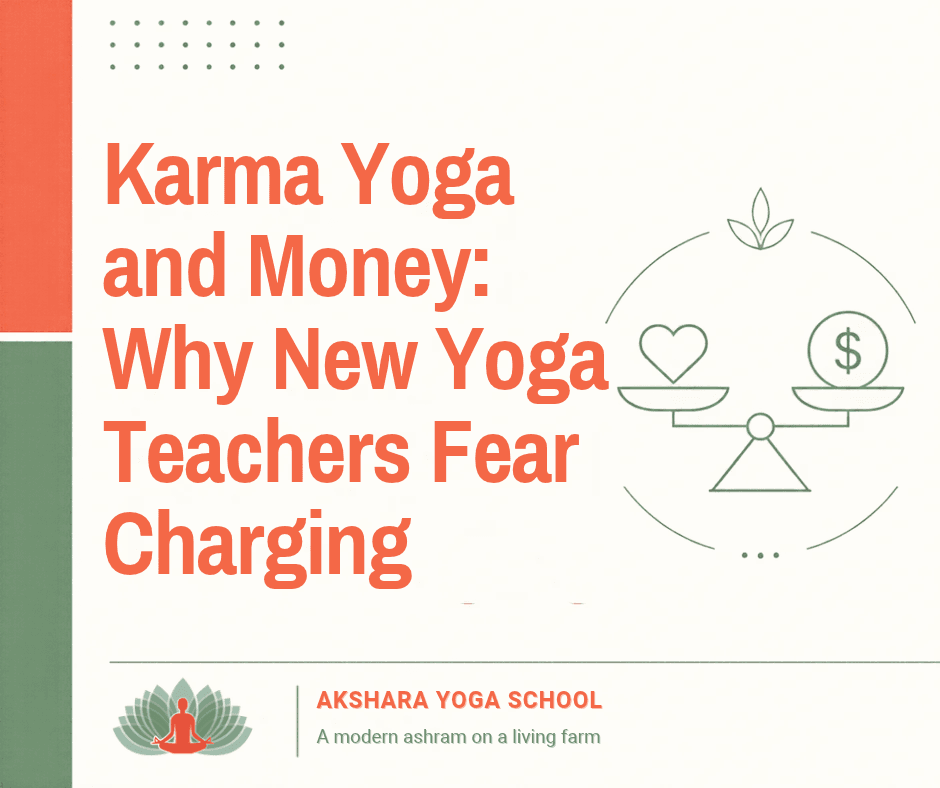
Separate Three Things: Service, Payment and Attitude
To get out of the trap, it helps to separate three ideas that often get mixed:
- Service (seva): Work you choose to give for free, for example a class at a community event. It is a choice, made on purpose.
- Payment: A fee for your time, training and skill. It allows you to keep teaching for many years.
- Attitude: How you work, with or without money. This is what Karma Yoga is about.
These three can exist together. You can charge for your regular classes and give one free class a month. You can be paid and still teach with patience and honesty. For Karma Yoga, the third point is the one that matters.
What Teaching for Free Can Cost
When free teaching comes from fear, both the teacher and the students lose something:
- A free class is easy to skip, so students may come less regularly.
- The teacher has less energy, less time to study and less money to keep learning.
- The teacher never practices talking about money, so the fear stays.
A stable teacher can support students for many years. A tired teacher cannot.
How to Set Your First Price as a New Yoga Teacher
- Decide your price before anyone asks. Look at what teachers with similar experience charge in your area. Choose a number that fits your level.
- Remember your level. Being new means you charge less than an experienced teacher. It does not mean you charge nothing.
- Practice saying it. Write the price down and say it out loud a few times. Your voice needs practice too.
- Keep it short. When a student asks, answer in one sentence: “My class is [price] per session.” Then stop talking.
- Stay steady. Keep the same price for a few months before you change it.
- Plan your free classes. Decide in advance when you will teach for free, and why.
Karma Yoga in Practice at Akshara Yoga School
During our 200-hour Hatha Yoga Teacher Training Course at Akshara Yoga School in rural northern India, we read verses from the Bhagavad Gita together. Then students spend one hour on a simple practical task. The goal is to observe their own attitude while working. Where does the mind go? Do they rush? Do they wait for praise?
This is how we approach Karma Yoga in our yoga teacher training: as a daily practice of watching yourself in action, not as a rule about money.
Final Thought
Getting paid for yoga and practicing Karma Yoga can be part of the same life. The first time you say your price, it feels strange. By the tenth time, it is just a sentence. And you keep your energy for what matters most: teaching well.
If you are looking for a yoga teacher training in India that explains yoga philosophy in a clear and practical way, explore our 200-hour Hatha Yoga Teacher Training Course at Akshara Yoga School.