What Is the Real Meaning of Hatha Yoga?
When people hear the term Hatha Yoga, they often associate it with physical postures, flexibility, strength, and endurance. However, traditional Hatha Yoga texts offer a deeper understanding of the practice. They describe Hatha Yoga as a discipline concerned with the relationship between the solar and lunar principles within the body and the regulation of prāṇa (vital energy).
The Siddha Siddhānta Paddhati, a traditional text associated with the Nātha yogic tradition, provides an important perspective on this subject. According to its teachings, Hatha Yoga involves understanding the relationship between the solar and lunar flows and learning to regulate the movement of prāṇa through yogic practices.
To understand this approach, we must first explore the significance of the sun and moon in Hatha Yoga.
The Sun and Moon in the Siddha Siddhānta Paddhati
हकारः कीर्तितः सूर्यष्ठकारश्चन्द्र उच्यते।
सूर्याचन्द्रमसोर्योगाद् हठयोगो निगद्यते॥
The verse associates the syllable ha with the sun and ṭha with the moon. Their union gives rise to the term Hatha Yoga.
This interpretation provides a symbolic framework for understanding yogic practice. The sun and moon represent complementary principles whose relationship is central to the traditional understanding of Hatha Yoga. Rather than treating them as competing forces, the practice seeks to bring them into a harmonious relationship.
This understanding also helps explain why Hatha Yoga involves much more than performing physical postures. Its traditional framework includes working with the breath, regulating prāṇa, and cultivating awareness of the body’s subtle processes.
What Are the Solar and Lunar Flows?
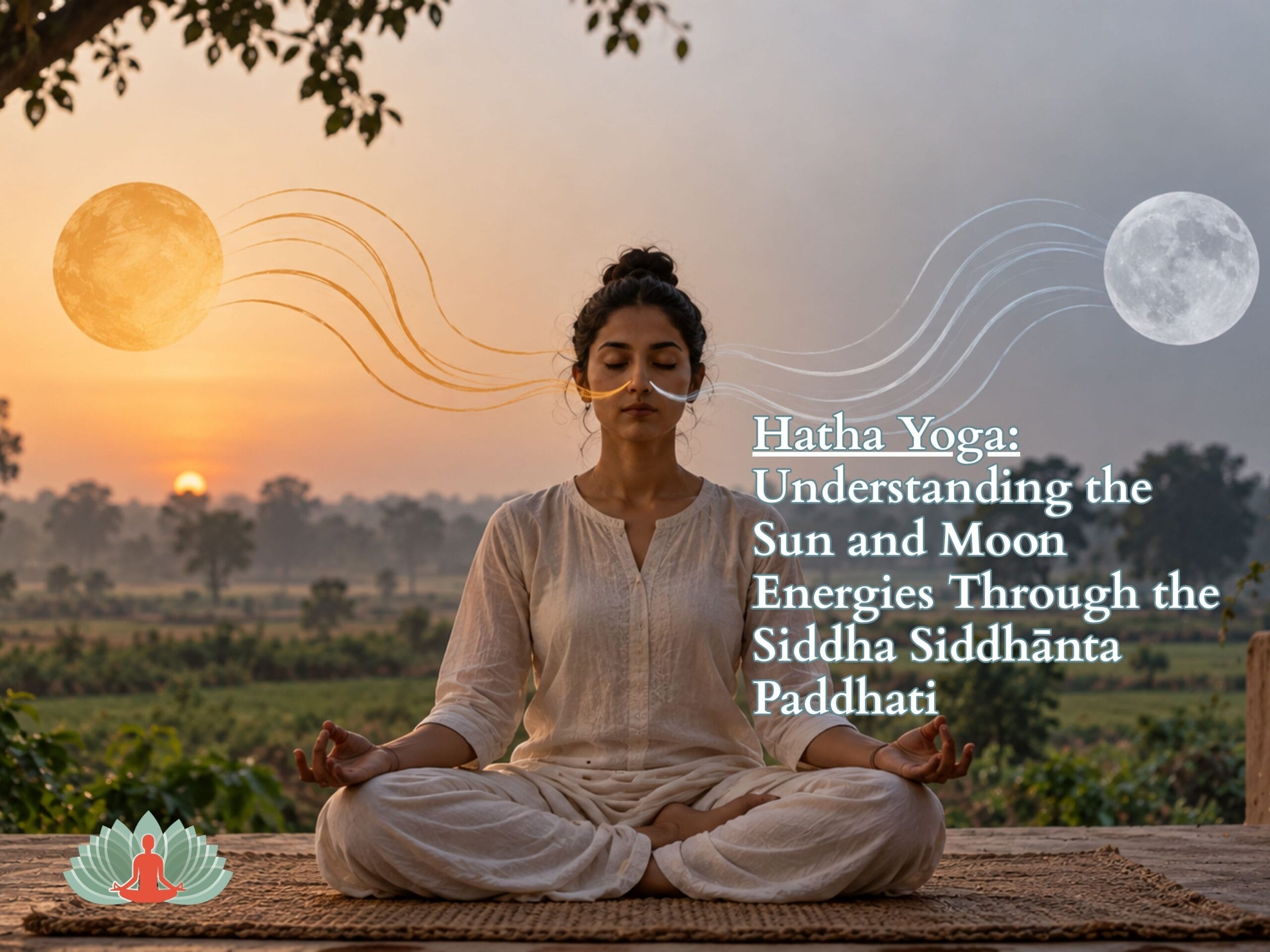
In traditional Hatha Yoga, the solar and lunar principles are associated with the movement of breath through the right and left nostrils, respectively. These flows are also connected with Piṅgalā and Iḍā nāḍī, two subtle channels described in yogic literature.
The right-nostril flow is traditionally associated with the solar principle, while the left-nostril flow is associated with the lunar principle. The sun represents qualities such as heat and activity, whereas the moon represents qualities such as coolness and receptivity.
These associations belong to the traditional yogic model of the subtle body. They offer practitioners a framework for observing the breath and understanding the relationship between different modes of activity and rest.
It is important, however, not to confuse this traditional model with established anatomical or physiological descriptions. The association between the nostrils and subtle energies is a yogic interpretation, not a direct measurement of energy flowing through anatomically identifiable channels.
The Breath as a Gateway to Awareness
One of the most accessible ways to explore this traditional teaching is through breath awareness.
Sit comfortably and observe your natural breathing without attempting to change it. Notice whether the breath seems to flow more freely through the right nostril, the left nostril, or both. Observe the sensations without immediately assigning them a particular meaning.
You may discover that the relative openness of your nostrils changes throughout the day. This is a normal physiological phenomenon, often associated with the nasal cycle, in which airflow alternates in relative dominance between the nostrils.
From the perspective of yogic practice, observing these changes can become an exercise in sustained awareness. Instead of breathing mechanically or attempting to control every aspect of the breath, you begin to pay attention to what is already happening.
The purpose of this observation is not to force the nostrils into an equal state. It is to develop sensitivity to the breath and to investigate the relationship between breathing, bodily sensations, and mental states.
From Effort to Balance: The Deeper Lesson of Hatha Yoga
The sun and moon offer a useful way to reflect on the relationship between activity and rest in everyday life.
We need activity to work, learn, make decisions, and respond to challenges. We also need rest to recover, reflect, and regain clarity. Excessive activity without adequate recovery can leave us exhausted, while insufficient activity can make it difficult to maintain discipline and direction.
Hatha Yoga provides a framework for investigating this relationship through practice. Rather than assuming that more effort always produces better results, practitioners learn to observe when effort is appropriate and when relaxation is needed.
This is especially important in physical practice. Forcing a posture may produce unnecessary tension, whereas appropriate effort combined with awareness can help develop stability and ease. Similarly, trying too hard to control the breath can create strain, while patient observation allows breathing to become more natural.
The deeper lesson is that yogic practice is not simply about increasing effort. It is about understanding how to apply effort intelligently.
Experience the Traditional Wisdom of Hatha Yoga at Akshara Yoga School
At Akshara Yoga School, we approach Hatha Yoga as a discipline that brings together physical practice, breath awareness, relaxation, and philosophical understanding. Our aim is to help students move beyond the external form of postures and develop a deeper understanding of the principles underlying their practice.
Through guided instruction, students learn to observe the body and breath, understand traditional yogic concepts, and approach practice with patience and discernment. Our philosophy classes complement practical sessions, allowing students to connect textual teachings with their own observations.
Set in the countryside of India, our school offers a learning environment where traditional yoga education meets personal attention and the simplicity of rural life.
Come experience yoga in the countryside of India, where tradition meets personal care. Choose from our 200-Hour Hatha Yoga Teacher Training Course, our 80-Hour Yoga Foundation Course, our Yoga Vacations, or contact us to create your own Tailor-Made Program.
Discover Hatha Yoga not merely as a practice of postures, but as a journey toward greater awareness, understanding, and balance.